



Journal
When a harness is better than a cart.
Unsteady is not the same as unable. How to tell which side of that line your dog is on.
Owners often arrive convinced they need a wheelchair when what would actually help is a harness, and occasionally the other way round. The two do genuinely different jobs and the distinction is worth getting right before spending several hundred dollars.
Two different jobs
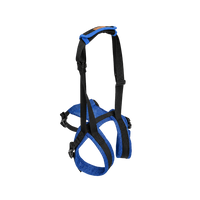
A support harness helps a dog who can still carry some of their own weight. You take a share of the load at the moments that are hard: the stairs, the car, the slippery patch of kitchen floor, the first few steps after lying down. The dog is still walking, you are assisting.
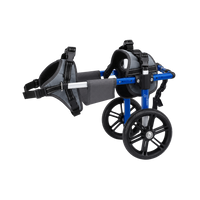
A wheelchair carries the weight for a dog who cannot. The frame does the supporting continuously and the dog propels. It is not assistance, it is substitution.
The weight bearing question
The question that separates them: can your dog hold their own weight on the affected legs, at least some of the time?
Watch over a few days rather than deciding in one moment, and watch on a floor with grip. A dog who slips on tile will look far worse than they are.
When a harness is the answer
- Your dog walks, but wobbles, particularly on turns.
- They can stand unaided but struggle to get up from lying.
- The problem shows up at specific moments: stairs, the car, the first minute of the day.
- They manage a normal walk but tire faster than they used to.
- They are recovering from surgery and need controlled support at the pace your vet has set.
This describes most dogs in the earlier stages of a progressive condition, most older dogs slowing down, and most post surgical dogs. A harness is also considerably cheaper, takes seconds to fit, and does not need the house rearranging.
When a cart is the answer
- The back legs no longer take weight, or give way as a pattern rather than occasionally.
- Your dog drags rather than steps.
- You are lifting for most of the distance, not just at the hard moments.
- Walks have shrunk to the end of the drive because that is all that is manageable.
- Your dog clearly still wants to go and is frustrated by not being able to.
That last point matters more than it sounds. A cart is worth it when the dog still has the appetite for movement. If the reason walks stopped is that your dog no longer wants to go, a cart is not the answer to that, and it is worth talking to your vet about why.
Using both
Most owners of dogs with progressive conditions end up with both, and use them differently. The cart comes out for walks and longer sessions outdoors. The harness lives by the door for the car, the stairs, and getting up in the night.
That is not duplication. Carts are cumbersome indoors and unnecessary for a thirty second lift, and harnesses do not carry a dog for a twenty minute walk.
If you can only buy one now, and your dog still bears some weight, buy the harness. It is cheaper, more immediately useful, and it will still be useful later when you do need a cart.
How to decide this week
Spend a few days paying attention to when you are actually helping your dog. If you find you are assisting at particular moments, you need a harness. If you find you are supporting continuously for most of the distance, you need a cart.
If it is genuinely unclear, film your dog walking on a non slip surface, side on, for twenty seconds. Send it to us with a note on what has changed and how quickly. We will tell you which we would be looking at, and if the honest answer is that you should be speaking to your vet before buying anything, we will say that instead.
This is not veterinary advice. We sell mobility equipment and we write about using it. We cannot diagnose your dog, and nothing here replaces an examination. If your dog's movement has changed suddenly, or they seem to be in pain, speak to your vet.
Want a second opinion on sizing?
Send us your dog's measurements and a photo of them standing side on. We will tell you what we would order, including when the answer is nothing yet.