


Product guide
Dog wheelchairs, demystified.
What they actually do, what they are made of, what the first week really looks like, and which of the things people say about them are nonsense.
Six things people say
Three myths and three truths.
Starting here because the myths are what stop owners buying, and they are mostly wrong.
It is the opposite. A cart is what gets a dog back out of the front door. Owners consistently describe the first proper walk as the moment the household mood changed.
Most dogs are uncertain for about two minutes and moving within a few days. The ones who struggle almost always have a fit problem, not an attitude problem.
Plenty of dogs use a cart for outings and walk unaided indoors. It is a tool for the hard part of the day, not a permanent state.
Frames are designed around it. Some owners still prefer to take the cart off. Both are normal.
Dogs adapt faster while they still have strength and enthusiasm. Waiting until they cannot move at all makes the learning curve much steeper.
Almost every unhappy cart we hear about is a measuring problem. Five minutes with a tape prevents nearly all of it.
Anatomy
Five parts, and what each one decides.
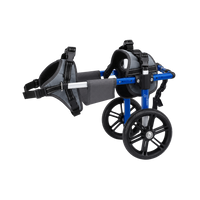
A dog wheelchair is a simple machine. Knowing which part does what makes every product page easier to read, and makes it obvious what you can and cannot fix with an adjustment.
- 01The frameThe load bearing part, sized from your dog's rear leg height. Get this number wrong and nothing else on the cart can rescue it.
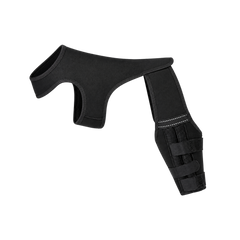
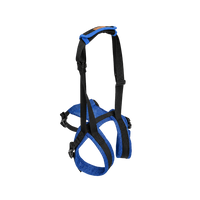
- 02The harness or saddleWhat actually touches your dog. Padding, strap width and placement decide whether they tolerate a long walk or shrug it off after five minutes.
- 03The wheelsSmall wheels for indoors and pavements, larger for grass, gravel and anything with a slope. This is the single biggest comfort difference outdoors.
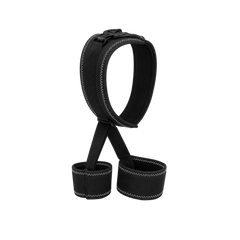
- 04The stirrupsOptional slings that hold the back paws off the ground. Essential if your dog knuckles, unnecessary if they do not.
- 05The adjustment pointsHeight, length and width. A frame that adjusts is a frame that still fits in six months when your dog's shape has changed.
The first week
What actually happens.
Not the marketing version. This is the pattern owners describe when it goes well.
Two to five minutes, twice. Let them stand in it and be praised for it. Many dogs freeze completely on the first go, and that is normal. Do not push or pull them forward.
Same again. Grass or short carpet, never tile. Stop while it is still going well rather than pushing for one more lap.
Somewhere around here most owners describe a moment where the dog realises the cart is a way of getting somewhere. Give them a reason to move: you walking ahead, dinner at the other end of the garden.
Five to ten minutes, twice a day. Watch for tiring rather than watching the clock.
Fifteen to twenty minutes somewhere familiar. Do not jump straight to a normal length walk, the muscles doing the work are new to it.
The practical bit
Questions worth asking.
Money, lifespan, wear, and what to do when it is not going well.
Ours run from around the low hundreds for a small frame to several hundred for heavy breed and full support models. The frame is the expensive part, and it is the part you should not economise on.
The frame outlives the dog in most cases. Straps and padding are the parts that wear. We do not stock spares yet, so if something wears out contact us and we will tell you honestly what the manufacturer offers.
No, and they should not. Carts are for sessions and outings. Skin under the straps needs checking after every use, and most dogs are happier resting out of the frame.
After a week of short positive sessions, refusal is nearly always fit rather than attitude. Send us a photo of your dog standing in it, side on, whole frame in shot. Fit problems are usually obvious in a photo.
You do not need a prescription. You do need a diagnosis, because the right equipment depends on what is actually happening, and some causes of sudden weakness are urgent.
One honest caveat. This page is about equipment. It is not veterinary advice and it cannot tell you what is wrong with your dog. A cart helps a dog who cannot carry their own weight, and it does nothing at all for the cause of that. If your dog's movement has changed suddenly, see your vet first.
Ready to find the right one?
Two minutes with the fit finder, or send us three measurements and a photo and we will do it for you.