


Guide
Rear support or full support?
Four questions about how your dog actually moves, and a straight answer at the end. Most owners need a rear cart. Some do not.
Question 1
Can your dog hold their own weight on their front legs?
Watch on a floor with grip, over a couple of days rather than one moment. A dog who slips on tile will look worse than they are.
Question 2
Can they push themselves up from lying down?
Using the front legs to lift the chest, even if the back end needs help.
Question 3
Where is the weakness?
If you are unsure, this is the question worth asking your vet before buying anything.
Question 4
Is the condition expected to progress?
Ask your vet if you do not know. It changes whether a convertible frame is worth the extra.
Based on your answers
Side by side
The honest comparison.
Including the parts that are less convenient, because a cart your dog will not use is not a saving.
| Rear support | Full support | |
|---|---|---|
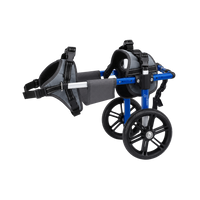
| Wheels | Two | Four |
| Carries | Hind quarters | Front and rear |
| Your dog provides | Front legs propel and steer | Very little, the frame holds them |
| Weight | Lighter | Noticeably heavier |
| Turning circle | Tight, fine indoors | Wide, needs open space |
| Typical learning time | A few days | One to two weeks |
| Who it suits | Back leg weakness with a solid front end | Weakness in all four limbs |
| Cost | Lower | Higher |
| Can it convert | Often takes a front attachment later | Already the full frame |
Before you buy
Common questions.
The four we are asked most about choosing between the two.
Usually not. A full support frame asks more of a dog, and for one who is already tired it can be too much. If progression is likely, a rear cart that accepts a front attachment later is the better buy.
Then it is worth a conversation rather than a purchase. Send us a twenty second video of your dog walking on a non slip floor, side on, and we will tell you what we would order.
Many models can, though not all. If your dog's condition is progressive, check that before you buy, because it saves paying twice.
Most dogs move confidently in a rear cart within a few days. A full support frame typically takes one to two weeks. Short positive sessions beat long ones either way.
Still not sure?
Send a short video of your dog walking on a non slip floor, side on, and a note on what has changed. We will tell you which type we would be looking at, and say so if the honest answer is neither yet.