


Journal
The first week in a wheelchair.
A realistic day by day of what to expect, how long sessions should be, and what to check after every one.
Almost every dog is uncertain in a cart at first, and almost every owner reads that uncertainty as rejection. It usually is not. What follows is roughly how the first week goes when it goes well.
Before the first session
Assemble the cart and adjust it fully before your dog sees it. Fumbling with straps while a confused dog stands in a frame is a bad introduction for both of you.
Pick your surface. Grass or a short pile carpet, not tile, not gravel, not a slope. Have treats to hand, and pick a time when your dog is alert but not wired.
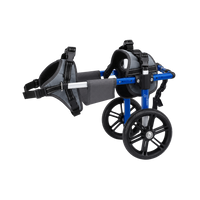
Set the height first. With your dog in the frame, the spine should be roughly level, the same line they hold when standing normally. Too high tips weight forward onto the front legs. Too low lets the rear drag.
Day one and two
Two to five minutes, twice a day. That is genuinely all.
Let your dog stand in the cart and be praised for it. Many dogs freeze completely on the first go. Do not push or pull them forward, and do not lift the frame to make the wheels turn. Wait, keep it light, and let them take one or two steps on their own. Then stop while it is still going well.
Some dogs walk off immediately. That is lovely, and it is still worth keeping the first sessions short, because the muscles being used are ones they have not used properly in a while.
Day three to five
Build to five or ten minutes, still twice a day. Introduce a reason to move: you walking ahead, a favourite person calling, dinner at the other end of the garden. Movement with a purpose comes far more easily than movement for its own sake.
This is usually where it clicks. Owners describe a moment where the dog realises the cart is a way of getting somewhere rather than a thing being done to them, and the whole tone changes.
Day six and seven
Fifteen to twenty minutes if your dog is comfortable, and a first short outing somewhere familiar. Watch for tiring rather than watching the clock. A dog who was trotting and is now plodding has had enough, regardless of what the plan said.
Do not go straight to a normal length walk. The cart changes which muscles do the work, and a dog who overdoes it in week one is often sore in week two and less willing as a result.
What to check every time
Take the cart off after every session and look properly. This takes thirty seconds and prevents most of the problems we hear about.
- Skin under every strap, especially the inside of the thighs and behind the front legs. Redness that fades within a few minutes is normal, redness that stays is not.
- The top of the back paws if the legs sit in stirrups or hang free.
- Whether the frame has shifted during the session, which usually means a strap needs tightening.
- Your dog's breathing and enthusiasm at the end compared with the start.
If it is not going well
If your dog is still refusing to move after a week of short positive sessions, the problem is nearly always fit rather than attitude. In order of likelihood: the frame is too high, a strap is too tight, or the length is wrong so the balance point is off.
Take a photo of your dog standing in the cart, side on, with the whole frame in shot, and send it to us. Fit problems are usually obvious in a photo and usually fixable in a few minutes.
If your dog seems to be in pain at any point, stop and speak to your vet rather than persisting.
This is not veterinary advice. We sell mobility equipment and we write about using it. We cannot diagnose your dog, and nothing here replaces an examination. If your dog's movement has changed suddenly, or they seem to be in pain, speak to your vet.
Want a second opinion on sizing?
Send us your dog's measurements and a photo of them standing side on. We will tell you what we would order, including when the answer is nothing yet.