


Journal
Rear support or full support, and how to tell.
Most owners need a rear cart. Some need four wheels. Here is how to work out which, and when it is worth sizing for the next stage instead of this one.
There are two broad categories of dog wheelchair. A rear support cart carries the back end and leaves the front legs to do the walking. A full support or quad cart carries both ends. They cost differently, they handle differently, and they suit very different dogs.
Getting this choice wrong is more expensive than getting the size wrong, because it is not fixable with an adjustment.
What each one does
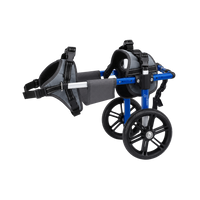
A rear cart is a two wheeled frame. The dog's front legs propel and steer, the frame carries the hind quarters, and the rear legs either rest in stirrups or move freely depending on the setup. It is lighter, more manoeuvrable, and easier for a dog to learn.
A full support cart adds a front axle and a chest support. The dog is held at both ends. It is heavier, wider, needs more room to turn, and takes most dogs longer to accept. It exists because some dogs genuinely cannot carry themselves at the front either.
Most dogs who need a cart need the rear version. That is not a sales position, it is just where the need sits.
The front leg test
The question that decides it is straightforward. Can your dog reliably hold their own weight on their front legs, and move them normally?
Watch them on a non slip floor over a couple of days rather than making the call in one moment. Look for whether the front legs buckle, whether the elbows tremble under load, whether they can push up from lying without help, and whether they can hold a stand for a minute or two.
If the front end is solid, a rear cart is almost certainly right. If the front end is visibly failing, that is a conversation with your vet before you buy anything, because front leg weakness has a different set of possible causes and some of them are urgent.
Signs a rear cart is enough
- The front legs bear weight normally and do not tremble under load.
- Your dog can push themselves up from lying, even if it takes effort.
- The problem is clearly located behind, whether that is dragging, crossing over, or the back end sinking.
- They still want to move and are frustrated rather than defeated by not being able to.
This describes the majority of dogs with degenerative myelopathy in its earlier stages, most post surgical rear leg cases, and most age related hind end weakness.
Signs to consider four wheels
- The front legs give way, not just occasionally but as a pattern.
- Your dog cannot hold a stand at the front even with the rear supported.
- A rear cart has been tried and the front end is clearly struggling to compensate.
- Your vet or rehabilitation professional has told you the condition is affecting all four limbs.
It is worth being honest here. A full support cart asks more of a dog, and for a dog who is already tired it can be too much. This is a decision to take with a professional who has examined your dog, not one to take from a website.
Buying for later
For progressive conditions, owners often ask whether to buy a quad cart now and grow into it. Usually the better answer is a convertible frame: a rear cart that accepts a front attachment later.
That way your dog learns on the lighter, easier setup while they still have the energy to learn, and you are not paying twice or asking them to manage a heavier frame before they need to. Not every model converts, so check that before you buy if progression is likely.
Worth knowing. Dogs adapt to a cart faster when they are introduced to it earlier, while they still have some strength and confidence. Waiting until they cannot move at all makes the learning curve much steeper.
Getting a second opinion
If you are genuinely unsure which category you are in, that is the point to ask rather than to order. Send us a short video of your dog walking on a non slip surface, side on, plus a note on what has changed and over what timescale.
We will tell you which type we would be looking at. Where the answer depends on something we cannot see from a video, which happens often, we will tell you that too and point you back to your vet.
This is not veterinary advice. We sell mobility equipment and we write about using it. We cannot diagnose your dog, and nothing here replaces an examination. If your dog's movement has changed suddenly, or they seem to be in pain, speak to your vet.
Want a second opinion on sizing?
Send us your dog's measurements and a photo of them standing side on. We will tell you what we would order, including when the answer is nothing yet.