


Journal
Living with degenerative myelopathy.
What tends to change and roughly when, what equipment helps at each stage, and the questions worth asking your vet early rather than late.
Read this first. Degenerative myelopathy can only be diagnosed by a vet, and several other conditions look similar in the early stages, some of which are treatable. If your dog has not been assessed, that is the first step, not equipment.
Degenerative myelopathy is a progressive disease of the spinal cord, most commonly seen in older dogs of certain breeds. It is not painful in itself, which is the detail owners find hardest to believe and also the one that matters most. Dogs with it are usually frustrated rather than suffering, and they typically remain bright, hungry and interested in life long after their back legs have stopped cooperating.
This piece is about living with it practically. It is not a clinical guide and it is not a substitute for the conversations you should be having with your vet.
What it is
The nerve pathways that carry signals between the brain and the hind limbs gradually break down. The dog loses coordination first, then strength, then function. Because the nerves that carry pain sensation are not the ones primarily affected, dogs generally do not appear to hurt, and many keep trying to walk long past the point where it works.
There is no cure. What there is, and it matters a great deal, is a lot of scope to keep a dog mobile, engaged and involved in the household for a long stretch of the disease.
How it usually progresses
Every dog is different and timelines vary widely. Broadly, owners describe something like this.
- Early: scuffed nails on the back feet, the odd stumble, crossing the back legs, a bit of wobble on turns. Easy to mistake for arthritis or just age.
- Middle: knuckling becomes frequent, the back end swings or sways, your dog struggles on slippery floors and needs help with stairs and the car.
- Later: the back legs no longer reliably support weight, dragging becomes constant, and a cart moves from helpful to necessary.
- Advanced: front limb involvement and continence changes can appear. This stage needs close veterinary input.
Progression is usually gradual rather than sudden. A sudden change is a reason to contact your vet, because it suggests something else may be happening alongside.
Equipment by stage
Buying everything at once is a common and expensive mistake. Equipment is much more useful introduced at the point it is needed.
- Early. Traction. Runners on slippery floors, non slip socks or paw grips, and a ramp for the car. This stage is about preventing falls and preserving confidence.
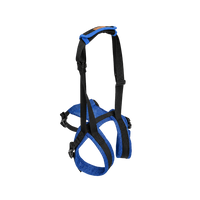
- Early to middle. Boots or toe protectors once nails start scuffing, before the skin on top of the paw breaks. A rear lift harness for stairs and getting into the car.
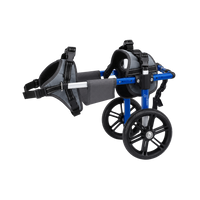
- Middle. A rear support wheelchair, introduced while your dog still has the strength and enthusiasm to learn it. Waiting is the most common regret owners report.
- Later. Full support options if the front end becomes involved, plus more attention to bedding, pressure points and hygiene.
The timing point. Owners who introduce a cart early, while their dog can still partly walk, almost always report an easier transition than those who wait. Ask your vet when they would start.
What helps day to day
The equipment is only part of it. The rest is the house and the routine.
- Cover slippery floors along the routes your dog actually uses, not the whole house.
- Keep nails short. Long nails change how the paw lands and make scuffing worse.
- Check the top of the back paws daily once knuckling starts. Skin damage there is easy to miss until it is a wound.
- Raise food and water bowls if standing to eat has become effortful.
- Keep walks short and frequent rather than long and occasional.
- Keep them in the room with you. Isolation is harder on most dogs than immobility.
Questions for your vet
Worth asking early, because the answers shape what you buy and when.
- Are there other conditions that could explain this, and have they been excluded?
- At what point would you recommend introducing a wheelchair?
- Is physiotherapy or hydrotherapy appropriate, and can you refer us?
- What should prompt me to call you rather than wait for the next appointment?
- What should I be watching for in the front legs?
- How do we monitor for pressure sores and urinary problems?
Looking after yourself
This is a long condition and the caring is physical. Owners routinely underestimate what daily lifting does to their own back, and a lift harness with a proper handle is as much for you as for the dog.
It is also emotionally heavy in a way that is hard to explain to people whose dogs are well. If you have access to a rehabilitation professional or a support group, both tend to help more than owners expect.
This is not veterinary advice. We sell mobility equipment and we write about using it. We cannot diagnose your dog, and nothing here replaces an examination. If your dog's movement has changed suddenly, or they seem to be in pain, speak to your vet.
Want a second opinion on sizing?
Send us your dog's measurements and a photo of them standing side on. We will tell you what we would order, including when the answer is nothing yet.