


Journal
Knuckling and paw dragging explained.
Why the paw turns over, what the damage looks like, and which products actually protect against it.
Knuckling is when a dog walks on the top of the paw instead of the pad, with the toes folded under. It looks strange and slightly comic the first time you see it, and it is a meaningful sign rather than a quirk.
What knuckling is
Placing a paw correctly requires the dog to know where the paw is without looking. That sense, proprioception, depends on nerve signals travelling from the foot to the brain and back. When that pathway is impaired, the paw is put down in whatever position it happened to be in, and gravity does the rest.
The dog is usually not aware it is happening, which is why they keep walking on it. That is exactly why the damage gets bad before owners notice.
Why it happens
Knuckling is a symptom, not a diagnosis. The underlying causes are various and some are serious. They include spinal cord conditions such as degenerative myelopathy and IVDD, nerve injury, some orthopaedic problems, and occasionally issues unrelated to the nervous system.
A dog who has started knuckling needs a vet to work out why. Buying boots without that step protects the skin while leaving the cause unaddressed, and if the cause is progressive that matters.
The damage it causes
The top of the paw is not built for contact with the ground. It has thin skin, no pad, and very little padding over the bone. Dragging it across pavement does predictable damage.
- Nails wear flat or split, often the first sign an owner notices.
- Hair rubs away over the knuckles.
- The skin abrades, then breaks.
- Open wounds develop, and because the dog keeps walking on them they do not get a chance to heal.
- Infection follows, and at that point it is a veterinary problem rather than a management one.
Check daily. Once you have seen scuffed nails, look at the top of both back paws every day. Dogs with impaired sensation do not tell you it hurts, because it may not.
What actually protects
The aim is a barrier between the top of the paw and the ground that stays on.
- Knuckling boots. Reinforced across the top rather than just the sole. Ordinary walking boots protect the underside, which is not the surface taking the damage.
- Toe or drag guards. A lighter option for mild or intermittent knuckling, less bulky and often better tolerated indoors.
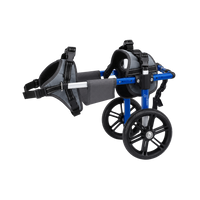
- A wheelchair. Where dragging is constant, a cart lifts the paw off the ground entirely, which solves the problem rather than mitigating it.
- Indoor traction. Not protection as such, but reducing slipping reduces the number of bad steps.
Fit is the whole game with boots. A boot that rotates or slips off leaves the paw unprotected while you believe it is covered. Measure the paw flat on the floor with weight through it, because a lifted paw measures narrower and that single error explains most boots that will not stay on.
What does not work
- Ordinary socks. They wear through in one walk and offer nothing on pavement.
- Bandaging the paw. It restricts circulation, holds moisture and is not made for repeated ground contact.
- Adhesive pads alone on a dog who is genuinely dragging. They are for grip on smooth floors, not abrasion resistance.
- Waiting to see whether it settles. Once the skin breaks the problem changes character.
When to call your vet
Call promptly if knuckling has appeared suddenly, if it is worsening, if there is any open wound, if there is swelling, heat or discharge, or if your dog seems painful. Also call if the knuckling spreads from one leg to two, or from the back legs to the front, because that is useful information for them.
Protection buys time and prevents secondary damage. It is not a treatment for the cause, and we would rather be clear about that than sell you a boot and let you think otherwise.
This is not veterinary advice. We sell mobility equipment and we write about using it. We cannot diagnose your dog, and nothing here replaces an examination. If your dog's movement has changed suddenly, or they seem to be in pain, speak to your vet.
Want a second opinion on sizing?
Send us your dog's measurements and a photo of them standing side on. We will tell you what we would order, including when the answer is nothing yet.