


Journal
How to measure your dog for a wheelchair.
Three measurements decide the size. Here is how to take them without a second pair of hands, and the two mistakes behind almost every exchange we process.
A dog wheelchair is not sized like a collar. It is a frame that has to hold a specific dog at a specific height, and if that height is out by an inch the dog either drags or is stood up on tiptoe. Neither is comfortable, and neither is something you can fix with a strap.
The good news is that the measuring itself is simple. It is a soft tape, a flat floor and about five minutes. Almost everything that goes wrong goes wrong before the tape comes out.
Why this goes wrong so often
Two errors account for most of the exchanges we handle. The first is measuring a dog who is not standing. The second is using a weight from the last vet visit.
A dog sitting, lying, or held up under the belly measures short at the rear leg, because the leg is not loaded and the joints are not stacked the way they are in a normal stance. The difference can easily be two inches on a medium dog, which is a whole size.
The weight problem is quieter. Dogs who have been struggling to walk lose muscle in the hind end, sometimes fast. A weight from four months ago can be several pounds out, and on a frame sized partly by weight that matters.
Do this first. Stand your dog on a non slip floor with weight through all four legs. If they cannot hold that unaided, have someone support them under the chest, not under the belly, so the rear legs still take load.
The three that matter
Rear leg height
Floor to the top of the rear leg, at the point where the leg meets the body. This is the single most important number for a rear support cart, because it sets the frame height. Measure both sides. Dogs with an old injury or uneven wear often stand asymmetrically, and you want the taller of the two.
Back length
From the base of the neck, roughly where a collar sits, to the base of the tail. Follow the spine, not the outline of the coat. On a long backed dog this decides frame length, and on a short backed dog it decides whether the cart will turn in your hallway.
Current weight
Weigh your dog this week. A bathroom scale works: weigh yourself, pick up the dog, weigh again, subtract. Weight determines axle and frame strength rather than height, which is why it functions as a cross check rather than a size on its own.
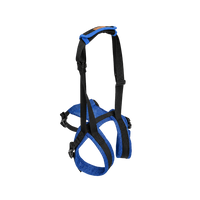
Two more are worth having even though they are not primary. Chest girth, taken around the widest part of the ribcage just behind the front legs, matters for the harness that comes with the cart. Front leg height matters if there is any chance you will need a full support frame later.
Taking them alone
It is easier with two people, but it is perfectly doable alone if you set up properly.
- Put a non slip mat down. A dog slipping mid measurement will shift their stance and you will get a short number.
- Stand your dog against a wall, side on. The wall stops them circling, which is the main problem when you work alone.
- Take the rear leg height first, while they are freshest and most settled. It is the number you cannot afford to get wrong.
- Write each figure down as you take it. Do not try to remember three numbers and a unit.
- Take everything twice. If two attempts disagree by more than half an inch, take a third and use the median rather than the average.
If your dog will not settle at all, break it across two sessions. A tired, stressed dog gives you bad numbers, and there is no prize for doing it in one go.
Reading a size chart
Most charts give a range per size, and most dogs land cleanly in one. What trips people up is the overlap at the edges, where a dog sits in the top of one band and the bottom of the next.
The instinct is to size up, on the logic that a bigger frame gives room to adjust. On a wheelchair that instinct is usually wrong. An oversized frame sits too high, pushes weight forward onto the front legs, and is harder for the dog to turn. Too big is not safer than too small, it is just a different failure.
Between two sizes? Send us the numbers rather than picking. It is free, it takes us a few minutes, and it is frequently a different model rather than a different size that solves it.
When the numbers disagree
Sometimes the rear leg height points at one size and the weight points at another. That is not a measuring error, and it is worth paying attention to.
A tall, light dog who has lost hind end muscle will read that way. So will a compact, heavy dog. Both are common in the population of dogs who end up needing a cart, and both are cases where the standard chart needs a human to look at it.
It can also mean a measurement was taken wrong, most often the rear leg height on a dog who was not fully standing. Retake that one first before assuming the chart is the problem.
Before you order
Send us the three numbers, the unit you used, and a photo of your dog standing side on. We will tell you what we would order and why. If we think a cart is premature and a harness would serve you better for now, we will say that too.
There is no charge for this and no obligation attached to it. It is simply cheaper for everyone than processing an exchange.
This is not veterinary advice. We sell mobility equipment and we write about using it. We cannot diagnose your dog, and nothing here replaces an examination. If your dog's movement has changed suddenly, or they seem to be in pain, speak to your vet.
Want a second opinion on sizing?
Send us your dog's measurements and a photo of them standing side on. We will tell you what we would order, including when the answer is nothing yet.
Journal
How to measure your dog for a wheelchair.
Three measurements decide the size. Here is how to take them without a second pair of hands, and the two mistakes behind almost every exchange we process.
A dog wheelchair is not sized like a collar. It is a frame that has to hold a specific dog at a specific height, and if that height is out by an inch the dog either drags or is stood up on tiptoe. Neither is comfortable, and neither is something you can fix with a strap.
The good news is that the measuring itself is simple. It is a soft tape, a flat floor and about five minutes. Almost everything that goes wrong goes wrong before the tape comes out.
Why this goes wrong so often
Two errors account for most of the exchanges we handle. The first is measuring a dog who is not standing. The second is using a weight from the last vet visit.
A dog sitting, lying, or held up under the belly measures short at the rear leg, because the leg is not loaded and the joints are not stacked the way they are in a normal stance. The difference can easily be two inches on a medium dog, which is a whole size.
The weight problem is quieter. Dogs who have been struggling to walk lose muscle in the hind end, sometimes fast. A weight from four months ago can be several pounds out, and on a frame sized partly by weight that matters.
Do this first. Stand your dog on a non slip floor with weight through all four legs. If they cannot hold that unaided, have someone support them under the chest, not under the belly, so the rear legs still take load.
The three that matter
Rear leg height
Floor to the top of the rear leg, at the point where the leg meets the body. This is the single most important number for a rear support cart, because it sets the frame height. Measure both sides. Dogs with an old injury or uneven wear often stand asymmetrically, and you want the taller of the two.
Back length
From the base of the neck, roughly where a collar sits, to the base of the tail. Follow the spine, not the outline of the coat. On a long backed dog this decides frame length, and on a short backed dog it decides whether the cart will turn in your hallway.
Current weight
Weigh your dog this week. A bathroom scale works: weigh yourself, pick up the dog, weigh again, subtract. Weight determines axle and frame strength rather than height, which is why it functions as a cross check rather than a size on its own.
Two more are worth having even though they are not primary. Chest girth, taken around the widest part of the ribcage just behind the front legs, matters for the harness that comes with the cart. Front leg height matters if there is any chance you will need a full support frame later.
Taking them alone
It is easier with two people, but it is perfectly doable alone if you set up properly.
- Put a non slip mat down. A dog slipping mid measurement will shift their stance and you will get a short number.
- Stand your dog against a wall, side on. The wall stops them circling, which is the main problem when you work alone.
- Take the rear leg height first, while they are freshest and most settled. It is the number you cannot afford to get wrong.
- Write each figure down as you take it. Do not try to remember three numbers and a unit.
- Take everything twice. If two attempts disagree by more than half an inch, take a third and use the median rather than the average.
If your dog will not settle at all, break it across two sessions. A tired, stressed dog gives you bad numbers, and there is no prize for doing it in one go.
Reading a size chart
Most charts give a range per size, and most dogs land cleanly in one. What trips people up is the overlap at the edges, where a dog sits in the top of one band and the bottom of the next.
The instinct is to size up, on the logic that a bigger frame gives room to adjust. On a wheelchair that instinct is usually wrong. An oversized frame sits too high, pushes weight forward onto the front legs, and is harder for the dog to turn. Too big is not safer than too small, it is just a different failure.
Between two sizes? Send us the numbers rather than picking. It is free, it takes us a few minutes, and it is frequently a different model rather than a different size that solves it.
When the numbers disagree
Sometimes the rear leg height points at one size and the weight points at another. That is not a measuring error, and it is worth paying attention to.
A tall, light dog who has lost hind end muscle will read that way. So will a compact, heavy dog. Both are common in the population of dogs who end up needing a cart, and both are cases where the standard chart needs a human to look at it.
It can also mean a measurement was taken wrong, most often the rear leg height on a dog who was not fully standing. Retake that one first before assuming the chart is the problem.
Before you order
Send us the three numbers, the unit you used, and a photo of your dog standing side on. We will tell you what we would order and why. If we think a cart is premature and a harness would serve you better for now, we will say that too.
There is no charge for this and no obligation attached to it. It is simply cheaper for everyone than processing an exchange.
This is not veterinary advice. We sell mobility equipment and we write about using it. We cannot diagnose your dog, and nothing here replaces an examination. If your dog's movement has changed suddenly, or they seem to be in pain, speak to your vet.
Want a second opinion on sizing?
Send us your dog's measurements and a photo of them standing side on. We will tell you what we would order, including when the answer is nothing yet.